
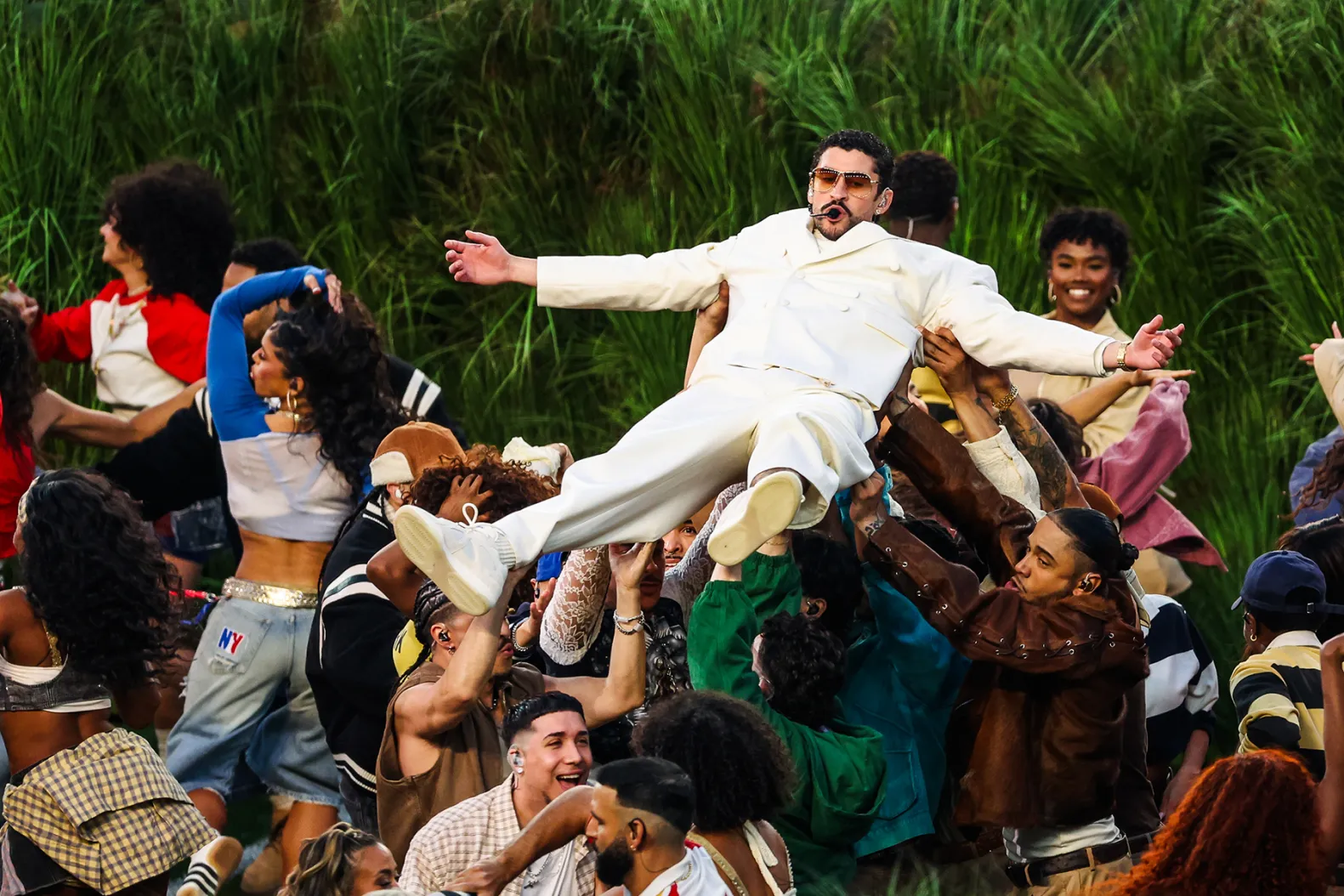
This past Sunday, for anyone unaware, was the Super Bowl. As a sporting event, it was unremarkable, a mostly tedious defensive stand-off yielding a slow but decisive victory for Seattle’s Seahawks (Seahawks 29 : Patriots 13). But between two uneventful halves of football, another battle was waged – the battle of the half-time shows.
In September 2025, the Puerto Rican superstar Bad Bunny was announced as the headliner for Superbowl LX. The announcement was met with mixed reactions – many excited for the global phenomenon to perform on the world’s largest stage, while others balked at the prospect of a half-time performance in Spanish. The conservative group, Turning Point USA (TPUSA), however, had a unique response. 11 days after Bad Bunny’s selection, TPUSA released plans to host their own Superbowl performance, a self-proclaimed ‘All-American Halftime Show’.
On February 2nd, months after their original announcement and only six days before the Superbowl, TPUSA announced Kid Rock – who also performed at President Trump’s inauguration party – as the headliner for their alternative halftime show. In the same announcement, TPUSA spokesperson Andrew Kolvet, urged viewers to tune in for “a halftime show with no agenda other than to celebrate faith, family, and freedom.”
Come Superbowl Sunday, both shows aired. From 8:12 – 8:25pm EST, Bad Bunny’s performance garnered an average of 127.7 million viewers, falling short of Kendrick Lamar’s record 133.5 million in last years Super Bowl halftime show, but exceeding numbers for the game itself, which averaged 124.9 million viewers throughout. Turning Point’s Halftime show, streamed on YouTube drew in 6.1 million viewers at its peak.
Kid Rock’s halftime performance was never expected to rival Bad Bunny’s, and the viewership reflects that. Nor were the performances themselves on par, Kid Rock’s show paling in comparison to the production value and story telling of Bad Bunny’s. But the mere fact of an alternative halftime show, and the attraction of millions of viewers to that show gave me deep pause and a fair streak of anger. It is an exceptional lesson in puerility – a childish outburst for a group that is mad about not getting their way. It also represents a trend of dangerous political leveraging which threatens to undermine the human tie which should connect all of us, without regard for race, creed, color or national origin.
The climate surrounding immigration is a worrying example of the dehumanizing power of politics. In the absence of political argument, there could be no justification for the daily acts of inhumanity which befall immigrants in this country – documented or no. Yet, the politicization of the subject has permitted the bypassing of human decency to justify cruel acts of violence and barbarism through economic argument and a cloying interest in national security. The coopting of immigrants as political tools by both Democrats and Republicans has successfully elevated the question of immigration enforcement above the level of humanity, encouraging logical discourse which too often makes numbers of immigrants – framing them as economic actors or crime statistics – and ignores their humanity. The humane treatment and due processing of immigrants is not an end to be justified by economic arguments – it is a right guaranteed by the U.S. Constitution, in recognition of the humanity of all people on this earth. Humanity and due process for all are American values, human values, not partisan ones. So why, then, has the topic of immigration strayed so far from its human roots?
For one, immigration occupies center stage as a tug-of-war issue between our nation’s major political parties. In efforts to strengthen their voter bases, both Republicans and Democrats rely on emotional issues to stir fervor and thus political support from their constituents. This means running platforms centered around emotionally engaging topics. Immigration – an exceedingly visible phenomenon – has historically been one of those topics. But, ironically, the use of immigration as a political rallying cry has precluded the development of effective policy with regards to immigration.
Despite a clearly flailing immigration system, major policy change surrounding immigration has been historically difficult to achieve. The last major update to our immigration policy came from a bill passed in 1986, when Reagan was president and both the Senate and House of Representatives were held by Democrats. Since then, many major bills have come to the floor and been struck down. This has resulted in the excessive use of immigration-related executive orders – or orders given by the president, leader of the executive branch. In his first presidency, the Migration Policy Institute found that President Trump issued 472 immigration-related executive orders. The reason why bi-partisan support has been so unattainable is hard to pinpoint. In 2018, political researcher Margaret Peters proposed an interesting idea that decreased business interest in low-skilled laborers since the 1980s has meant the loss of Republican support for immigration, and thus the impossibility for bi-partisan support. But the political motivation behind support for immigration is not the issue at hand. In fact, the search for any political motivation to support or oppose immigration is the exact thing I caution against. Human issues should not be political issues. Human issues may find progress in political decisions, but the predominance of political theory over empathy is unacceptable. By establishing a spectrum of political opinion as the primary lens through which we view immigration, we have created a climate in which the acceptability of one’s opinion is determined by degree of deviation from the center-point of that spectrum, rather than considering the consequences of our opinions in their absolute senses.
For example, the good immigrant argument. Visualize the aforementioned spectrum of opinion. On one end resides absolute opposition to immigration. Here lies unabridged support of mass deportation efforts and approval of President Trump’s proposal to revoke birthright citizenship. On the other end of the spectrum, an opposite political extreme – absolute acceptance of immigrants. Here we may include legal protection and support for all immigrants regardless of criminal history or documentation, and perhaps free movement across borders (a reality which has existed in the EU since at least 1993). These extremes are well established bookends for in the question of national opinion – the Niskanen Center, a centrist D.C. based think tank poses that “our immigration debate has been hijacked by the political extremes and framed as an all-or-nothing binary between wide open or hermetically sealed borders.” In the context of these extremes, a commonly adopted midline opinion may read something like: yes, we should allow immigration, so long as immigrants enter through legal and regulatable routes, and so long as immigration policy does not permit the entrance of criminals and other likely detriments to our society. This is a stance I hear commonly and confidently adopted as one that is empathetic, while staying within the supposed realm of reason.
The preponderance of this opinion is reflected in a series of interesting poll results released by the Pew Research Center in December 2025, regarding American opinion on President Trump’s deportation efforts. One poll found that 82% of Americans believed ‘Some’ or ‘All’ immigrants present in the U.S. illegally should be deported (31% said ‘All’, 51% said ‘Some’). This result, I believe, justifies my claim that selective deportation is accepted as a moderate stance on immigration policy in our current political climate. And though I have many arguments on the fallacy of that political opinion, it is not, ultimately, what concerns me most today. What concerns me most is the notion that, for many, strength of political opinion seems to be overshadowing our vital human tendency towards compassion, leading us to view immigrants first in the context of political arguments that surround them, and only secondarily as people. The experience of this reality for anyone would be taxing, much more so for people already isolated by language and cultural barriers, many of whom came to the U.S. to escape lives bereft of freedom or opportunity.
I work supporting immigrants through the legal processes of applying for citizenship. To be eligible for U.S. citizenship, most applicants must have had their Legal Permanent Residence for at least 5 years. This means that the vast majority of clients I speak with have a longstanding legal right to work and reside in the United States. Still, every day, I find myself reassuring clients, legal US residents, who are driven to terror and anxiety by being Hispanic, Haitian, Arabic, non-white, non-native English speakers here in the United States. Even in Boston, a blue city in a blue state with extensive protections against ICE and federal overstep, legal residents are scared to speak their native language in public, scared to attend school or work, terrified to raise families, or even to leave the country to visit families that they have left behind.
Their fear does not grow from imagined threats. It grows in the constant circulation of horror stories that have befallen other immigrants. It grows, too, in the unkindness of strangers, the cold reception by neighbors who do not lead with humanity. It grows even in neutrality, because when fear’s coloring is pervasive, neutrality cannot exist.
Most of us are political actors only in rare moments. Every 2 or 4 years when we cast our ballots, then, perhaps, we are political actors. But, in the meantime, there is no reason for our politics to lead us, especially not when our politics preclude our humanity. A smile costs nothing. An effort to understand the daily realities for modern immigrants in this country costs nothing and may benefit you a world of perspective. To walk with your neighbor through their troubles is the essence of humanity, and to use your energy to understand and uplift another is the growth of your soul.
There is a poem I love by the Chilean poet, Pablo Neruda. It is titled El Monte y El Río – The Mountain and the River. To me, it speaks of the beauty all humans are capable of.
–
In my homeland there is a mountain. / In my homeland there is a river.
Come with me.
Night climbs to the mountain. / Hunger goes down to the river.
Come with me.
Who are those who suffer? / I do not know, but they are mine.
Come with me.
I do not know, but they call me / and they tell me: “We suffer”.
Come with me.
And they tell me: “Your town, / your unfortunate town, / between the mountain and the river,
with hunger and with pain, it does not want to fight alone, it is waiting for you, friend”.
Oh you, that which I love, / small, red grain / of wheat,
it will be hard, the fight, / the life will be hard, / but you will come with me.
–
Do not trade the easy justification of selfishness for the beautiful reward of humanity. Cast a ballot as you will, that is a hill I will die on another day, but do not bring those political reasonings to bear in the purely human interactions of your everyday life. Instead, bring your humanity. Bring the person across from you, and the person you want to be. Bring the willingness to offer a part of yourself for the benefit of someone else.
The Turning Point halftime show can be justified in a hundred different ways. TPUSA themselves endorsed it as a family event without political agenda. But the message such counterprogramming sends is unequivocal in its negativity. It implies that a Hispanic, Spanish speaking headliner is neither appreciated nor wanted. It is a message meant to alienate. Bad Bunny’s halftime performance had political undertones too, but more than that it was a representation of a beautiful culture, beautiful language and thoughtful artistic expression that any viewer was lucky to experience. For 20-odd minutes, tens of millions of viewers had the opportunity to engage with Puerto Rican culture in a way they likely had never before – an ode to a home island choreographed by an impressive artist and creative mind. Most of all, it was a moment of rare representation for millions of Hispanic people around the U.S., an opportunity to feel appreciated on a massive stage during a time too often defined by suffering.
Our political opinions are mountains of cotton – towering and insubstantial, liable to disappear in a morning wind. The strength of our humanity is a moving river, feeding the earth we inhabit, creating culture, society and relationships which are the greatest touchstones of our happiness. This river turns the wheels of progress and offers succor upon the difficult path of life. Atop the mountain humanity looks small. Let us stand by the river instead. On the horizon, the mountain appears large, the river still flows beneath the mountain’s shadow.
Nick